
If your marketing isn’t working, there’s a good chance it’s a people problem.
Modern work rewards visible activity. If you look busy, people assume you’re a top performer — even when that activity doesn’t move anything forward.
So it’s not surprising that leadership, particularly in marketing, has fallen into this same trap where activity gets mistaken for leadership.
Today, many marketing leaders believe leadership is pointing to others and saying, “Do.”
Then they get to work on the business of said “real” leadership: emails, edits, pings and “Just checking in 一 done yet?” messages on Slack.
But emails and edits aren’t leadership.
It can look like leadership from the outside, but it’s performance. And performance is demanding. It leaves little room for actual leadership — establishing clarity, aligning teams, providing context and lining people up to deliver on projects and hit goals.
When you’re stuck performing, things like empathy, curiosity, patience and investment in others are the first things to go because they start to feel like annoying “delays.”
And that’s no bueno in a big way because those are the very things that make leadership and collaboration work at all.
Here’s what this all looks like in real life.
When Your Marketing Isn’t Working, It’s Usually Because People Are Treated As Obstacles To Overcome, Not Partners
Joe from Marketing is leading up a project. The stakes are big. Bringing this thing to completion is dependent on all of the players involved successfully working together.
Joe needs to loop in Ron’s pod over in Customer Success and two folks from Aisha’s team in design.
He needs to circle back with Vlad from his own team. Joe explains what he wants to Vlad the same way every time (no adjustments, no curiosity) and he just can’t understand why Vlad still doesn’t “get it.”
Joe’s stakeholders are his CMO and COO. So annoying I have to run things by them,” Joe thinks. “Necessary evil. I’ll loop them in after kickoff.”
He also has the agency in the mix. He thinks Tina is great, but she’s always asking so many questions.
Here’s what it looks like as Joe executes what he thinks is leadership:
- STEP 1: He kicks things off with a group email outlining the project in vague terms. He then tags everyone on Slack with a single instruction to read his email.
- STEP 2: Joe sees Kenji from Ron’s team in the break room while the guy is trying to eat his lunch and tells him all about his priorities for the project. He assumes Kenji will tell the rest of the customer success folks and they’ll figure out their parts.
- STEP 3: He’s pretty busy so he decides to skip booking an alignment meeting with Aisha since her and her team already know about the project and blocked out time for it. After all, Joe did mention it to her during the walk downstairs to the company all-hands meeting earlier this month.
- STEP 4: He decides he’s not going to “waste his time” talking to Vlad again. If Vlad has any questions he’ll just tell him to “figure it out.” After all, that’s the answer he received from his own bosses early in his career whenever he had questions.
- STEP 5: He calls and leaves a voicemail for Tina at the agency with some word salad that doesn’t resemble anything even close to the project brief format they agreed upon last quarter.
- STEP 6: He drops a recurring meeting on everyone’s calendar without checking anyone’s availability.
The kick-off meeting? Half the invite list didn’t show. The meeting itself? Mostly Joe talking, very little listening.
Joe stresses this project is a real priority and name-drops a few VIPs to prove it (“Dave is really going to be paying close attention to this and how it goes!”). He asks those present to catch up all the folks who didn’t attend the call.
But by the end of Week 1, Joe’s PM board is bare. Tasks have owners, but there are no updates.
When he notices the lack of movement, he pushes harder. Emails, fly-bys, pressure.
He meets with his COO and CMO to update them on the plan and progress. But there are no updates and there is no progress. Not his fault, though. So he uses the allotted time to trash everyone involved and suggests firing the agency.

Bruh…
An absolute dumpster fire. Failed before it could even start.
Joe managed these people like obstacles to overcome and handled alignment like it was annoying admin work. Then he acted shocked when nothing moved.
He didn’t give any of the people involved what they actually need from a leader.
I’m talking about the requirements that make other humans willing and able to follow you.
Things they don’t just want, but need:
- RESPECT: Someone who treats them with respect and dignity.
- EMPATHY: Someone who considers their priorities and respects their time.
- ACTIVE LISTENING: Someone who hears them when they speak and doesn’t just wait for their own turn to talk.
- VALUE: Someone who recognizes the context in which they fit into the bigger picture.
- PATIENCE: Someone who welcomes questions, understands their need for background and is open to hearing feedback.
As a result, the outcome was predictable. It fell apart just like so many “underperforming” marketing initiatives because the foundational elements that make collaboration possible were absent.
In other words: The project failed because Joe never led these people. He only executed tasks.
Managing tasks is the performance of leadership. It only looks like leading from the outside. The true work of leadership would have been working side-by-side with these colleagues from start to meaningful finish.
Unfortunately, if you told Joe this, he’d say, “But I did lead them! It didn’t work!”
The best thing you could say to him at that point would be, “… no, you didn’t.” Not in any way that mattered.
When “Bad Hiring” Is Really A People Leadership Problem
Most orgs don’t immediately call this a leadership problem. They call it an execution problem. From the outside, it just looks like work that won’t move.
But when the work keeps stalling and results fail to materialize, leadership eventually recognizes it for what it is — a hiring problem.
The “wrong hire” isn’t usually the one who can’t do marketing. It’s the one who can do the work, but can’t lead other people.
This isn’t an edge case. It’s the norm. The numbers back it up:
- 82% of leaders do not possess the ability to lead and work with others. – Gallup
- 80% of employee turnover is due to bad management hires. – Harvard Business Review
It’s not a coincidence these numbers are functionally identical.
And people leadership isn’t just a top-down thing. It shows up in how you work with everyone — up, down and sideways.
When leaders get it wrong, what follows are campaigns that don’t deliver, employee turnover and “why isn’t marketing working?” discussions during QBRs with top brass.
For most of us, the reason so many get leadership wrong is simply that we were trained from the start to manage tasks, not people.
To chase the grand “win” instead of building sustainable machines that work in harmony and produce consistent results.
And it’s not hard to see why. This gap is baked directly into the modern perception of what a leader looks like, as well as the leadership mantras we love to cite and quote.
How Leadership Culture Keeps Skipping the Hard Part 一 Other People
Every few years, business culture latches onto a new source of wisdom. Most of the time it’s not even bad advice.
Take the following that has made the rounds in recent years:
“What stands in the way becomes the way.”
Or often cited as “the obstacle is the way.” Leaders say it in meetings, managers use it to motivate teams and founders hang it on their walls.
It’s powerful shorthand for the idea that the obstacles we face aren’t barriers at all and are instead catalysts. They are opportunities — to do our best, learn and grow.
But here’s where our leadership culture gets things twisted. That’s not the full quote. The part that gets skipped is the part that actually matters:
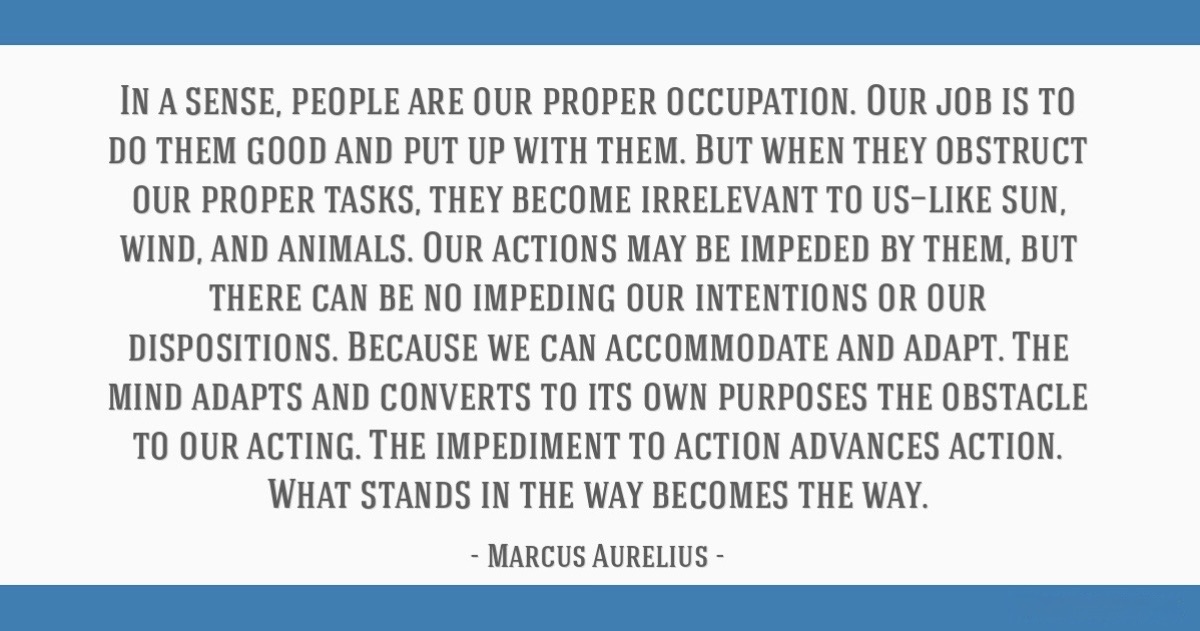
“In a sense, people are our proper occupation. Our job is to do them good and put up with them.”
We love the obstacle story, but we skip the people part.
Deep down we know that our obstacles rarely look like bad luck or conspiring forces. They look like people.
“People are our proper occupation” is just a fancy way of saying your real job every day is how you work with them.
Most leaders would nod and agree: “Absolutely. People are our proper occupation. People always come first.”
And they walk in every Monday morning fired up and ready to treat everyone like an obstacle.
“People first” is easy to say, but harder to act on.
How Do We Fix This? By Owning The Reason Leadership Fails to Deliver In The First Place
So back to our friend Joe from marketing. Let’s say you see a bit of yourself in him. The question becomes, now what?
The fix begins by reframing perception of the people around us and reminding ourselves that they are the key to achieving great things.
The shift is simple in theory, but it takes effort. It’s especially important in marketing where collaboration so often defines outcomes.
But it’s also simply required of us as decent human beings.
Done well, it allows one to bypass anything even remotely similar to the nightmare project scenario outlined above.
Here’s where everything starts to turn around if there is willingness to abide:

Stakeholders: From “Annoying” Approvals to Consensus
Stakeholders (internal or otherwise) aren’t just “people with demands” or necessary sign-offs. They bring perspective and insight that shapes success. Shifting your view of their role and what they bring to the table reframes “seeking approval” into building consensus. That leads to stronger alignment and a higher probability of success. Those are good things!
✅ KEY TAKEAWAY: Reframe “stakeholder approval” into “consensus with key collaborators.”
⮕ What Joe Should Have Done: He should have involved his CMO and COO early, clarified expectations, and built alignment before sprinting ahead. That would have turned the CMO and COO from last-minute judges into early partners, so Joe wasn’t walking into an exec update empty-handed and pointing fingers while the room silently concluded he was the real problem.
Your Team: From “Overseeing” to Empowering
Your team isn’t an arbitrary assortment of people that work outside your door. They are your core allies. Each member possesses the strengths that bring you closer to your end goal. Listen when they talk. Adapt to them. Give them what they need. Empowering them will drive results.
✅ KEY TAKEAWAY: Reframe “managing your team” into “setting your allies up for success.”
⮕ What Joe Should Have Done: He should have asked Vlad what wasn’t clear, adapted his communication and given him what he needed to succeed — not repeated the same direction over and over and hoping something would magically click. This would have given Vlad ownership, removed confusion early and saved Joe from bottlenecking his own project.
CROSS-FUNCTIONAL TEAMS: FROM “HEADACHE” TO HOW IT GETS DONE
Cross-functional teams aren’t necessary headaches or a bunch of randos you’re “forced” to work with. They exist because no single function holds the keys to the kingdom. Marketing knows what’s marketable. Design knows what it’s supposed to look like. Customer Success knows what keeps customers. So on and so forth…
✅ KEY TAKEAWAY: Reframe “dealing with other teams” into “recognizing these folks know what you don’t.”
⮕ What Joe Should Have Done: He should have met Ron’s pod and Aisha’s team where they were, asked what they were balancing and made it obvious what they’d all stand to win when the project succeeds. That would have launched things with shared momentum and prevented the project from dying on the runway.
AGENCIES: FROM “OUTSIDERS” TO INSIDERS WITH PERSPECTIVE
External agencies and contractors aren’t doorstops for delegation. They aren’t outsiders who “just don’t get it.” They are partners with specialized expertise and fresh eyes that can catch the blindspots, of which there are usually many.
✅ KEY TAKEAWAY: Reframe “coordinating with the agency” into “integrating their expertise.”
⮕ What Joe Should Have Done: He should have sent Tina a clean brief, asked for her input and patiently answered her questions instead of treating them like a headache. This would have set Tina and her team up for delivering nothing but upside to the project.
People Are The Real Work Of Marketing Leadership And The Key To Delivering Results
The work of leadership isn’t managing the work itself while riding a bulldozer to the finish line.
If your marketing isn’t working, it’s usually not your strategy or your tactics. It’s the people-side of execution: alignment, ownership and how you lead.
It’s always about people. They’re the path to achieving great things. They don’t stand in our way, they are the way.
Adjusting to this mindset starts with how you frame the people around you.
I’ve seen what happens when the framing is off. I’ve also been the one who got it wrong.
The fix is found by working with people, not against them. That’s the job. That’s the real work of leadership. And it’s the hardest part.
FAQ: Why Your Marketing Isn’t Working
Most of the time it’s not because your strategy is "wrong." It’s because the work gets stuck in collaboration. People are unclear on the goal, priorities and ownership. This makes projects stall, turns updates into finger-pointing and nothing gets done.
Often, yes. Marketing leadership is mostly people leadership, and that is where results live or die. When leaders treat people like obstacles, default to managing tasks and spending time focusing on tactical details instead of leading, nothing ships.
Managing tasks is chasing updates, editing the deck, and tracking boxes. Leading people is creating clarity, aligning expectations and making it easy for others to execute without confusion or rework.
It means involving stakeholders early, aligning on what "success" means, and using updates to get decisions and remove blockers. If you show up late with no progress and a blame list, you don’t look "busy." You look like you don’t have control.
Treat them like partners, not obstacles. Ask what they’re juggling, agree on what they own, and make the shared wins obvious. If people don’t know why it matters or what "done" looks like, the project dies on the runway.
Give them a clear brief, context on what matters and room for questions. Agencies can move fast when they’re treated like collaborators. The results they produce are only as good as the brief, the context and the access you provide.