
Are you a successful professional that feels like a fraud or a failure? Do you enjoy those feelings? Yeah, I didn’t think so. But here’s the thing 一 you’re not alone.
It’s a phenomenon that has been studied extensively. It’s called imposter syndrome and it manifests itself as persistent feelings of self-doubt, particularly among working professionals. I’ll let Harvard Business Review take it from here:
“Imposter syndrome can be defined as a collection of feelings of inadequacy that persist despite evident success. ‘Imposters’ suffer from chronic self-doubt and a sense of intellectual fraudulence that override any feelings of success or external proof of their competence. They seem unable to internalize their accomplishments, however successful they are in their field. High achieving, highly successful people often suffer, so imposter syndrome doesn’t equate with low self-esteem or a lack of self-confidence.”
Experiencing imposter syndrome at work seems to be its own special kind of difficult. Feelings of professional inadequacy seem to impact the smartest and most accomplished people I know.
It has even led these same individuals to question if they should change careers.
They simply can’t shake a persistent and nagging feeling that their “incompetence” will be discovered and their careers will be over.
What is going on here?
Here’s What The Research Says About Imposter Syndrome
Research shows imposter syndrome is not just common, but highly prevalent.
According to an in-depth look at the phenomenon by the Journal of Mental Health & Clinical Psychology, imposter syndrome affects people across all ages and professions.
While it was initially identified largely among high-achieving women, research now shows men are equally susceptible.
When digging into statistics on how prevalent imposter syndrome is among business leaders, the issue becomes much starker.
According to research cited by Fast Company, a whopping 78 percent of business leaders have experienced imposter syndrome and more than half of those polled (52 percent) in the same survey reported that workplace imposter syndrome affected their ability to effectively lead their business or team.
The fallout from from all this is far from insignificant.
McLean Hospital, which runs the largest private neuroscientific and psychiatric research program in the world, cites research showing individuals who suffer from imposter syndrome face a high risk of developing anxiety and depression.
That risk increases when faced with failure, and can then lead to heightened levels of low-self esteem.
Yikes. This simply needs to be addressed. Fortunately, there is research on how to mitigate the negative effects of this It starts with sharply recognizing what imposter syndrome truly looks like.
So What Does Imposter Syndrome Look Like? How Does It Show Up?
I recently attended a workshop hosted by Micha Goebig where the topic of imposter syndrome was thoroughly explored along with ways to effectively deal with it.
Goebig’s research-backed presentation showed there are several common thoughts that propagate within the minds of professionals who experience imposter syndrome at work.
Do any of these look familiar?
- “I just got lucky.”
- “I’m good at being in the right place at the right time.”
- “They’re going to figure out I’m a fraud.”
- “They made a mistake by hiring me.”
- “They have low standards.”
- “It’s because they like me.”
- “I’ve had a lot of help and have connections.”
“Okay,” you say to yourself. “I’ve had those thoughts before, but you don’t really know me!”
Well, about that…
What Are The 5 Major Types of Imposter Syndrome?
Take a moment to review the infographic below. Breathe it in and reflect on what it says.
Now be honest — do any of these strike a chord?
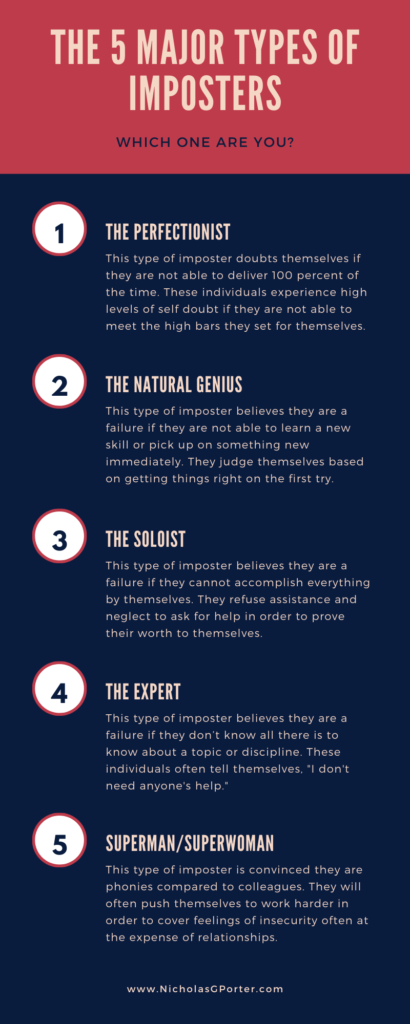
Source: Micha Goebig and Fast Company.
How To Overcome Imposter Syndrome At Work: 6 Strategies That Can Start Working For You Today
Are you finished freaking out? Good. Because not all hope is lost.
According to Goebig, there are several tips on how to overcome imposter syndrome that when implemented can start yielding results quickly and effectively.
Break The Silence
Sometimes it only takes a single conversation with someone you trust. Take the time to talk to someone about the feelings of self-doubt you’re you experiencing and you will likely discover that same person also struggles with the same thoughts and emotions.Separate Feelings From Facts
Understanding how to overcome imposter syndrome involves recognizing the difference between feelings and facts. Take a hard look at your accomplishments. Review them objectively. Through this lens, a pattern is likely to emerge. You’ll realize It was you who earned that degree. It was you who secured that job. It was you who closed that deal. Start believing the facts sitting right in front of you.Recognize Your Expertise and Abilities
Ask the people you trust what they truly think of you. Yes, this requires courage, but those closest to you will care enough to give you an honest assessment. Ask them what they think of your skills and abilities. Take their feedback and create a quick and dirty resume for the person they described. The final step in this process? Recognize the person represented is you.Develop a New Response To Failure
There are typically two responses to failure. You either let it hold you back or you turn it into an opportunity to learn and improve. Take a moment to consider the folks you know who seemingly exhibit the ability to bounce back from anything. Take some of their cues and integrate them into your own routine. And realize that failure rarely results in the catastrophic results the mind tends to conjure.Stop Catastrophizing
Think about the times in your life when things didn’t turn out the way you expected. Did they result in catastrophic failure? They rarely do. Remind yourself as often as possible that the human brain has an incredible knack for conjuring up worst case scenarios.Reward Yourself
Don’t ignore your accomplishments. Enjoy a meal at your favorite restaurant. Purchase that pair of shoes you’ve been eyeing. Take a vacation. The key here is to acknowledge such activity is a reward for what you’ve accomplished. Otherwise, you risk feeling guilty for “indulging.”
Imposter poster syndrome can feel overwhelming, but remember you’re not alone and there are practical and simple steps you can take to overcome it.
By breaking the silence and applying the right strategies, you can change negative self-perception, nagging feelings of self-doubt, and better appreciate your personal worth.
What are your tips for overcoming imposter syndrome? How do you deal with it?
FAQ: How to Overcome Imposter Syndrome at Work
FAQ: How to Overcome Imposter Syndrome
Imposter syndrome is when you feel like a fraud even though your track record says otherwise. You downplay your wins, doubt your abilities and worry people will “find you out” despite evidence you are competent and capable.
Research shows imposter syndrome affects men and women across ages and careers. One study found about 78 percent of business leaders have felt it and more than half say it has hurt their ability to lead their team.
Common signs include explaining success as luck, timing or help. There is also worrying others will figure out you are a fraud, thinking people “made a mistake” by hiring you and brushing off your achievements as no big deal even when they clearly are.
Start by talking about it with someone you trust, separating feelings from facts and asking for honest feedback on your strengths. Redefine failure as a chance to learn, stop catastrophizing and reward yourself for real wins so your brain starts to believe the evidence.
Imposter syndrome rarely disappears overnight. The goal isn’t to never feel doubt again. It’s to notice the “I’m a fraud” story faster, compare it to the facts and respond differently. Over time, practicing new responses (reframing failure, tracking real wins, asking for feedback) makes the old script feel less convincing.
Not exactly. People with imposter syndrome often have strong resumes and clear achievements but struggle to believe their own track record. They’ll acknowledge other people are talented but treat their own success as luck, timing or help. Low self-esteem is a broader more general negative view of yourself while imposter syndrome is more about not being able to internalize your competence and abilities at work.