Posts Tagged ‘Social Networking’

Social Media and Pizza: A Case Study

April 22nd, 2010

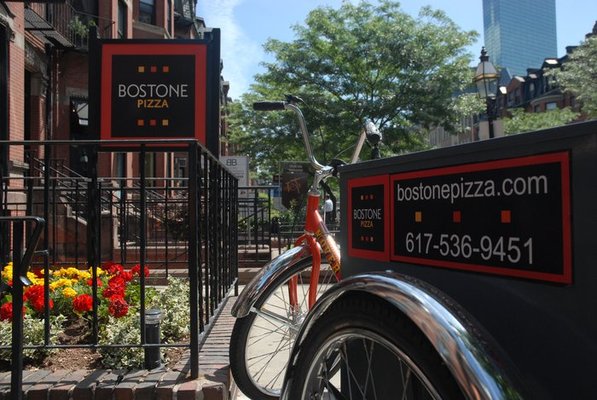
I live and work in downtown Boston, MA. When it’s time for lunch, I have many options. Today, I wanted to try a new place. I wandered down Newbury Street and decided to check out Bostone Pizza.

Bostone Pizza claims that they are Boston’s “only authentic NY pizzeria, featuring thin crust Neapolitan and deep dish Sicilian pizza.”

I tend to like my pizza covered with the most outrageous toppings you can think of.  I also love it prepared in a variety of ways. For this reason, Bostone caught my attention. But when it’s my first time in a joint? I opt for a straight slice of cheese. That’s just how I roll.

Well, the slice did not disappoint. But you must remember that there are tons of lunchtime options around here. Newbury Street alone offers everything from Indian/Chinese fusion to Spanish tapas. How can a pizza parlor compete?

I think Bostone is going to be just fine.

While dining, I checked in on Foursquare. I also chose to share my location on Twitter. Within an hour, Bostone sought me out and recognized my patronage. Trust me; this sort of thing makes a difference. I think that many of Boston’s plugged-in professionals and undergraduates would agree.  

The next time I’m looking for lunch in downtown, I think I’ll try Bostone’s Mediterranean with extra feta.

How to Use Social Media in Your Job Hunt

April 14th, 2010

I know plenty of folks who are looking for a job, yet refuse to join social networking sites like Twitter, LinkedIn and Facebook. It’s as if they are trying to prove something. The only thing they are proving is that they don’t understand how the rules have changed. Here are a few tips on how to use social media to find the job you deserve.

Make Your Debut

Whether you are an established professional or a graduate looking to catch a break, you must take the appropriate steps to establish your online identity. Start a blog that focuses on your professional interests and then create accounts on Twitter, LinkedIn and Facebook to promote your endeavor. 

Employers are not going to seek you out. You must make sure your voice is heard loud and clear.

Share the Right Information

When using Twitter to aid your job-hunt, you must be somewhat strategic. What sort of information are you sharing? If you are not reading and re-tweeting articles that cover topics relevant to your field, you are not doing all you can to brand yourself online. That account executive at XYZ PR is not going to notice you if you are solely tweeting about Cheetos and Jean-Claude Van Damme movies. Well, that would probably catch my attention, but I’ll save that for another blog entry…

Go Against the Grain

Do you have an opinion? Do not be afraid to share it! Let’s face it, the social media landscape is filled with @-kissers who love to offer groundbreaking comments like “great post!” on all the hottest blogs. The folks who stand out are those who respectfully voice differing opinions and engage others in conversation.

Pull the Trigger

So you’ve built your online presence and traded messages with a few established professionals. Now what? Pull the trigger!

Ask your new contacts if they would be willing to sit down for an informational interview. This is an excellent way to learn more about your industry and put yourself in front of the people who matter the most.

Think you are done? Not by a long shot!  Ask your social media contacts if you can contribute to their blog as a guest. Start a Twitter-Chat or organize a Tweet-Up. Ask everyone for referrals. Above all else, stay relevant!

Do you have a success story you are willing to share?

How the iPhone has Changed My Life

March 2nd, 2010

I’m a bit late to the iPhone party.  Actually, scratch that.

I waited until I could purchase the device at a reasonable price – and that is not something I am ashamed to admit.  When an upgrade offer of $99 for the phone with a two-year contract came to my attention, how could I say no?

As an iPhone user for a little over a month now, I have difficulty remembering how I functioned without it. Today, I’m going to share with you a few apps that have changed my life.

Facebook for iPhone and Echofon

I’m going to lump these two applications together. Do they really need an introduction? Well, yes. Not everyone sits on TechCrunch all day. Elitist bloggers please take note!

Facebook for iPhone allows access to your Facebook account in ways you never imagined. The application has a grid-like menu that provides easy access to all of Facebook’s most important features and makes sharing photos incredibly easy. Push notifications  – which should have been a no-brainer from the start – only recently arrived, but who cares? It’s just an added bonus. I would have used it no matter what. Afterall, this is Facebook – we use it, we love it and we cannot live with out it!

Echofon is routinely touted as the best free Twitter app on the market.  It loads fast, offers multiple features and allows you to view profiles with ease.  Although push notification features are only available by purchasing Echofon Pro, I’m not terribly disappointed.

Pandora

Distractions – i.e. real life – have disrupted my intake of music over the years. I no longer attend local shows as often as I once did and I’ve become less willing to take risks with my discretionary income. The solution? Pandora Radio!

After entering a song or artist you enjoy, the service automatically selects music and artists that are similar. Although I was already familiar with Pandora, I was overjoyed to hear there was a Pandora app available for the iPhone. Pandora is the type of service that seems made for mobile devices. I would have to guess that users get way more mileage out of this app than they ever would just using the web-based version.

Are you familiar with the Music Genome Project? If not, take a look. It’s an incredible project and the reason why you can enjoy Pandora today!

Dragon Dictation

Dragon Dictation is a speech recognition program that translates your spoken word to text. Once translated, you can text or email instantaneously. Its accuracy is quite impressive and it also allows you to add punctuation.  The app has received some rave reviews with good reason; long texts and emails now take only seconds to create and edit before before they are ready to be sent.

However, usefulness alone has not been enough to shield Dragon Dictation and its creator Nuance from controversy.

As TechCrunch reports, some terms of the service’s End User License Agreement lit up the blogsphere late last year when word that the app collects the names in your address book became publicized.

Nuance soon issued a statement explaining that it only collects contact names so Dragon Dictation can better recognize them during the translation process. The company also issued an update to the app which gives users the opportunity to not share this information upon first use. 

Dragon Dictation is too good to be free. Hop aboard before they start charging!

Honorable Mentions:

TweetDeck

I have been toying with Tweetdeck for the past couple weeks and I find it to be incredibly useful. It has become especially handy when I participate in Twitter chats from my phone because it allows me to create streams divided by hashtags.

Can 19% of the market really be wrong?

I Am T-Pain

Okay, the I Am T-Pain app really didn’t change my life, but it is a hell of a lot of fun to play around with. Even CNN thinks so!

Use this app to sing along to your favorite auto-tuned cuts from T-Pain himself.  Once complete, simply upload them and share with friends!

Zombie Hunter (7DA)

I have not wasted this much time on a videogame since the halcyon days of Nintendo.

If you are as big a zombie fan as I am, you have to check out ZombieHunter 7DA. You will find hours of delight in cutting down hordes of the undead while completing various missions designed to help save the world from “mutation.” The graphics on this game are top notch and the replay value is through the roof! Best of all, it’s free!

What are the iPhone apps have you been using?

Social Media: What Should You Be Sharing?

November 17th, 2009

Have you ever wondered why some folks blog about what is really obvious?

Potential employers are doing background checks by using social media? Really? “Re-tweeting” is a great way to spread information on Twitter? No way!

For a long time, I assumed these posts were purely for SEO purposes. I then realized these posts exist because they really are needed. I am constantly amazed by some of the material I see shared by individuals who actively use social media – especially Twitter – to professionally brand themselves. That being said, here is a quick reminder of what you should actually be sharing…

Your Personal Side

I have written about this before, and my opinion still stands. It really doesn’t matter what the Social Media Elite have to say about what you had for lunch. You must convey to the public that you are a human being. That means talking about on your favorite sports team, your favorite music and even your favorite food.

My answers!

1) The Boston Red Sox

2) Hardcore punk and metal

3) Indian food – all day, everyday!

Your Thoughts and Opinions…Within Reason

Acting like a robot is pretty self-defeating. The folks who stand out are not afraid to go against the grain. If you have a differing opinion, don’t be afraid to share it. You will be surprised by the amount of people willing to get to know you because of it. This does not mean, however, that you should be screaming from the rooftops about every controversial topic you can think of. It is usually a good idea to stay away from politics and religion.

My answers!

1) I contemplate deleting my Facebook account daily.

2) The reason I stay clear of political debates is because most people are not interested in sharing ideas. They are interested in telling you why you are wrong.

3) Alf’s real name is Gordon Shumway. Did you know that?

Everything but the Kitchen Sink

Twitter is not just about tweeting. In fact, there are a whole slew of activities you can take part in such as file sharing, activism and even some game playing. Just because you are using the service for professional purposes, doesn’t mean you cannot have a little fun, right?

Check out Mashable’s list, “Things to Do on Twitter Besides Tweet.”  This will help you accomplish all of the above. These guys will never steer you in the wrong direction.

My answers!

1) Not really an answer here. Instead I am going to fully admit that some of these tools are lame.

Did this post help? I hope so. I think I actually learned from it!

What did you learn? You can at least tell me your favorite food…

I'm, Ron Burgundy?

Stay Classy, Twitter!

Are You An Early Technological Adopter?

September 23rd, 2009

Apparently we are doomed and there is nothing that can stop our inevitable decline. It’s all your fault too. You just had to answer your cell phone didn’t you?

It’s completely cliché to hear about how technology touches our lives on a daily basis. It is also equally cliché to hear about how technology lowers our intelligence and is weakening our social fabric. This is still an argument I hear today!

If the latter is in fact true then American’s really are in the midst of downward spiral. That is because according to a recent study conducted by Forrester Research, we are embracing technology faster than ever before. An excerpt:

“According to the study, which surveyed 53,668 households in the United States and Canada by mail, half of all American adults are gamers. Sixty-three percent of American households have a broadband Internet connection. Three-quarters of American households have cellphones and PCs. And nearly 10 million American households, out of nearly 118 million, added an HDTV in the last year, a jump of 27 percent over 2007.”

Sure, landlines and analog televisions are things of the past and the practice of sending letters is steadily going the way of the buffalo…But has that really affected your life? Most likely not, especially when numbers like those above prove that the race to become early technological adopters has indeed gone mainstream.  I think what the study really proves is not our societal decline, but that digital immigrants are becoming relics of a very recent past.

In many ways this is nothing new because our society has always focused on progress and the old guard has always tried to fight it. That is because those who do not understand the future usually fear it. But it looks like the old guard is coming around a bit faster these days…and I say cheers to that!

What do you think?

Tech

Social Media and Abuse of Trust?

September 16th, 2009

Tim Otis at Daily Axiom recently spoke about what he labeled “social media @-kissers.” These are individuals who abuse social media trust by using social media in a strategic manner. Here is an excerpt from the article:

“I feel as though we’ve really abused the issue of trust in some ways, and have actually redefined the notion of it by simply kissing up to blog writers via comment, retweeting Twitter posts—and for what? Their approval? Since when is approval even remotely close to trust? Being connected is all about approval, not about trust. Somehow social media has blurred those lines and people are listening to it.”

This is certainly not a new concept. Many folks have recognized this for quite sometime and I commend Tim for speaking out on something he feels strongly about. In many ways, I agree with him.

Reading further, Tim notes what we should all know about social media. It’s about being natural:

“…I’ve found the same thing time and time again: [social media is] about being natural. The minute you’re forcing something to go through to reach your targeted audience, you will fail, because it reeks of being contrived.”

Tim’s post got me thinking about the true effectiveness of social media, especially Twitter, so I shared my thoughts on his blog. I agree with his points regarding abuse of trust issues, seeking SM celebrity approval and agenda-setting, but I do not necessarily think that it derails the effectiveness of the service. That is because in many cases, Twitter is an extension of our real life actions.

I was reminded of the “Twitter is a cocktail party,” comparison. When one goes to a cocktail party or networking event, many work the room with a purpose. Some people act natural and some come off as phony. The phony can obviously be spotted miles away, yet I’ve seen both strategies result in the same successful outcome.

Is this right? Is it wrong? Will we ever truly know?

What I do know is that at the end of the day, you will always be able to find me hanging out with the “natural” crowd.

Twitter's Biggest Flaw is Finally Exposed

June 18th, 2009

I am not surprised that Twitter has become the medium of choice among Iranians protesting their country’s recent presidential election. It seems though that during its finest hour, the social networking site’s biggest flaw is  finally being highlighted on a global scale.

Twitter is an amazing service. But it also has an extremely low barrier of entry, which in turn dilutes its effectiveness.

The amount of mindless re-tweeting that has occurred in recent days is astonishing. I understand that the average user is not going to subscribe to a rigorous vetting process when it comes to verifying information, but this no excuse to blindly spread the same message about YouTube removing videos highlighting the violence in Tehran when they are doing the exact opposite.

Issues like this emphasize my concerns about Twitter’s sustainability.  In many ways, it is the epitome of the high school rumor gone nuclear.

Don’t get me wrong though. I’ll be micro-blogging until my fingers fall off.

Sometimes you just have to take the good with the bad.

Sociology and Social Networking

June 17th, 2009

Emile Durkheim was a French sociologist who is often considered the founding father of the field. He held distinguished views on the topic of social solidarity. Social solidarity seeks to recognize the interactions and shared values that hold relationships together. According to Durkheim, social solidarity falls under two categories: mechanical and organic.

Mechanical solidarity refers mostly to a society that is linked mostly by the similarities that are shared by its members. Members often share the same lifestyle, values and experiences. Rituals and routines are very common and help build their collective conscience. Mechanical solidarity focuses on primary and familial relationships.

Organic solidarity refers to society whose members are highly individualistic but interact in order to achieve a common goal. Members are dependent upon one another and very often do not share the same lifestyle, values and experiences.  Organic solidarity puts a large emphasis on secondary relationships.

Below is a chart from the Collins Dictionary of Sociology which defines the two in a bit more detail:

Feature

Mechanical solidarity

Organic solidarity

Morphological (structural) basis

Based on resemblances (predominant in less advanced societies)
Segmental type (first clan-based, later territorial)
Little interdependence (social bonds relatively weak)
Relatively low volume of population
Relatively low material and moral density
Based on division of labour (predominately in more advanced societies)
Organized type (fusion of markets and growth of cities)
Much interdependency (social bonds relatively strong)
Relatively high volume of population
Relatively high material and moral density

Types of norms (typified by law)

Rules with repressive sanctions
Prevalence of penal law
Rules with restitutive sanctions
Prevalence of cooperative law (civil, commercial, procedural, administrative and constitutional law)

Formal features of conscience collective

High volume
High intensity
High determinateness
Collective authority absolute
Low volume
Low intensity
Low determinateness
More room for individual initiative and reflection

Content of conscience collective

Highly religious
Transcendental (superior to human interests and beyond discussion)
Attaching supreme value to society and interests of society as a whole
Concrete and specific
Increasingly secular
Human-orientated (concerned with human interests and open to discussion)
Attaching supreme value to individual dignity, equality of opportunity, work ethic and social justice
Abstract and general

This brings me to the social networking movement that has exploded in recent years. Everyone under the sun and probably beyond it has already told you this.  No matter what way you spin it, the advent of these new technologies has changed the way we communicate forever.

But Myspace, Facebook and Twitter have also undoubtedly created their own communities.

One might automatically assume that the types of relationships formed through social networking communities fall under the model of organic solidarity but I think that if you take a closer look, you might be surprised.

Either way, I think it is important to remember that Durkheim would also not care “What 80’s Hair Metal Rock Star” you are.